
Customer lifecycle management maps every customer to a stage, acquisition, activation, retention, expansion or win-back, and defines what should happen next at each. It's the strategy layer that Marketing Automation then executes against.
What's included?
- Lifecycle stage definitions specific to the business model
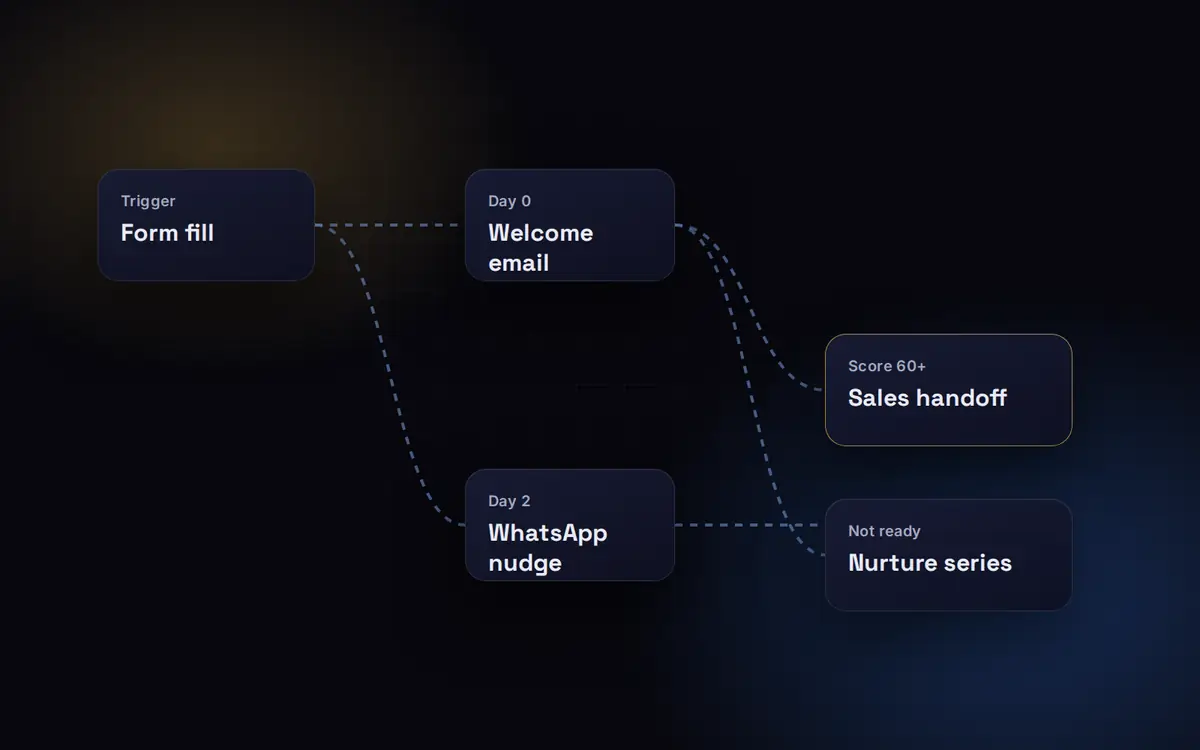
- Trigger mapping for movement between stages
- Data unification across touchpoints for stage accuracy
- Revenue-expansion plays (upsell, cross-sell) built into the later stages
Growth leaks after the first sale
Most businesses spend almost all of their marketing budget on acquisition and very little on what happens next. Yet Bain's research, summarised in Harvard Business Review, found a 5% increase in retention can raise profits by 25% to 95%, and acquiring a customer can cost five to 25 times more than keeping one (Harvard Business Review, 2014). Lifecycle management is the strategy that stops customers leaking out of the bottom of the funnel.
The stages we map
| Stage | The question | Typical triggers |
|---|---|---|
| Acquisition | Did we attract the right people? | Source, first page, first offer |
| Activation | Did they get value quickly? | First purchase, first use, onboarding steps |
| Retention | Are they coming back? | Usage drops, reorder windows, renewal dates |
| Expansion | Would they buy more? | Usage limits, related products, team growth |
| Win-back | Can we bring them back? | Lapse period, cancellation reason |
What good looks like
Duolingo's product team found that improving retention of current users had five times the impact on daily active users of any other lever, and raised current user retention by 21% (Lenny's Newsletter, Jorge Mazal). You do not need Duolingo's scale to apply the lesson: find the behaviour that predicts retention, then design messages and offers that encourage it.
Email metrics can mislead. Apple's Mail Privacy Protection, live since September 2021, preloads images and inflates open rates (Litmus on Apple Mail Privacy Protection). We judge lifecycle programmes on actions and revenue, not opens.
What we deliver
A lifecycle map with triggers, messages and owners for each stage, the metrics to track, and a build plan executed through marketing automation and email marketing.
How we measure it
Activation rate, repeat purchase or renewal rate, churn by cohort, expansion revenue and customer lifetime value.