
Why Answer-First Content Wins in the AI Search Era
AI answer engines retrieve chunks, not whole pages, and roughly 44% of LLM citations come from the first third of a page. Content that buries its answer under persuasion or backstory simply doesn't get cited, regardless of how good the information is further down.
What makes a passage citable
- Self-contained sections that make sense lifted out of context
- A specific number or dated fact, not a vague claim
- No hedging language ("we believe", "arguably") that signals uncertainty
- Tables for anything comparative, which extract more cleanly than prose
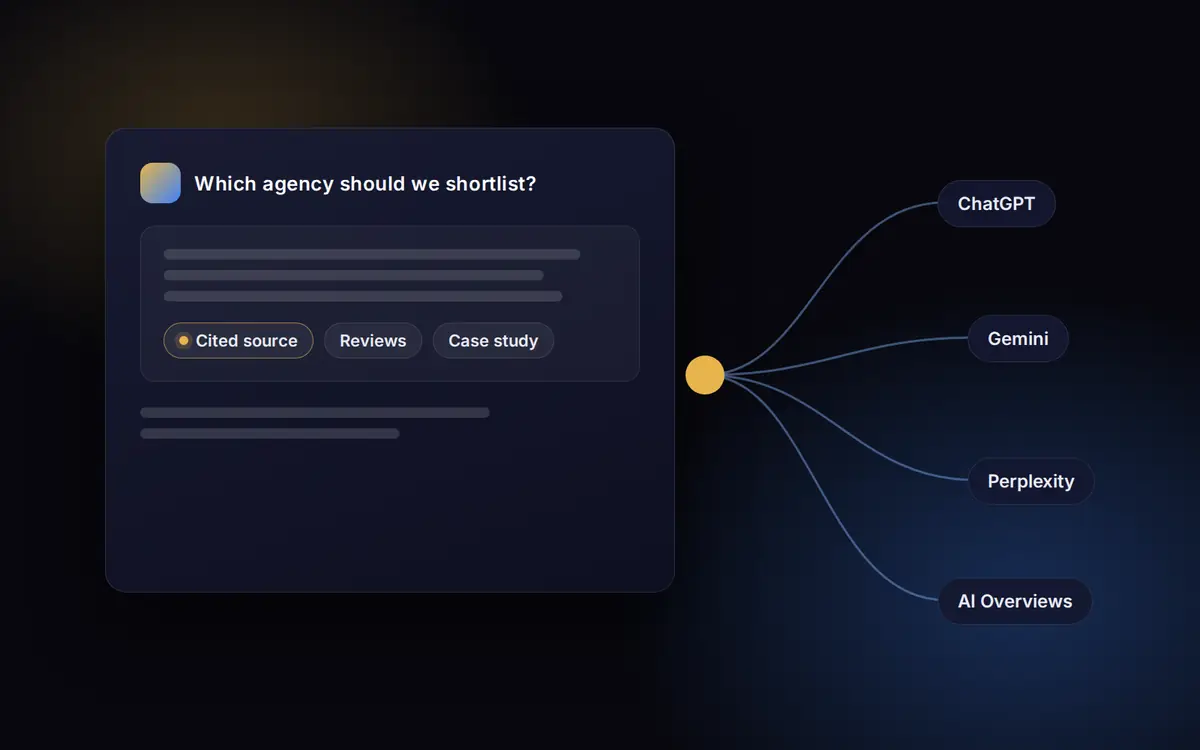
Why answers need to come first
AI search tools pull passages, not whole pages. When someone asks a question, the model looks for text that answers it clearly and can stand on its own. If your answer is buried under an introduction, a story and a sales pitch, a competitor's clearer paragraph gets used instead.
What the research says
The most cited study on this, presented at KDD 2024 by researchers from Princeton and IIT Delhi, tested nine content changes and found that adding statistics, quotations and citations could increase visibility in generative engine answers by up to 40%, while keyword stuffing did not help (Aggarwal et al., GEO, KDD 2024). The practical lesson: specific, attributed facts get used.
The scale is already large. Pew found that around one in five Google searches in March 2025 produced an AI summary, and people clicked a link inside that summary in just 1% of visits (Pew Research Center, July 2025). Alphabet said in 2026 that AI Overviews reach around 2.5 billion monthly users (Alphabet via The Motley Fool, Aug 2026), and ChatGPT reported 900 million weekly active users in February 2026 (TechCrunch, Feb 2026).
How to write an answer-first section
- Use the question as the heading
- Answer it in the first one or two sentences, with a specific number or fact where possible
- Add the detail, evidence and nuance after the answer
- Name your sources and link to them
- Keep each section self-contained, so it makes sense if lifted out on its own
Answer-first does not mean robotic. Write the answer the way a knowledgeable person would say it out loud. Clarity and personality can coexist.
What else helps AI engines use your content
Make sure content is in the HTML rather than loaded by JavaScript, use valid structured data (Google: structured data intro), and keep facts consistent across your site and other places your business is described. See AEO and GEO and our GEO glossary entry.