
GEO Services: Get Cited in AI Answers
When an AI assistant writes an answer, it picks a few sources to trust and a few brands to name. GEO is the work of becoming one of them, and proving it with numbers rather than screenshots.
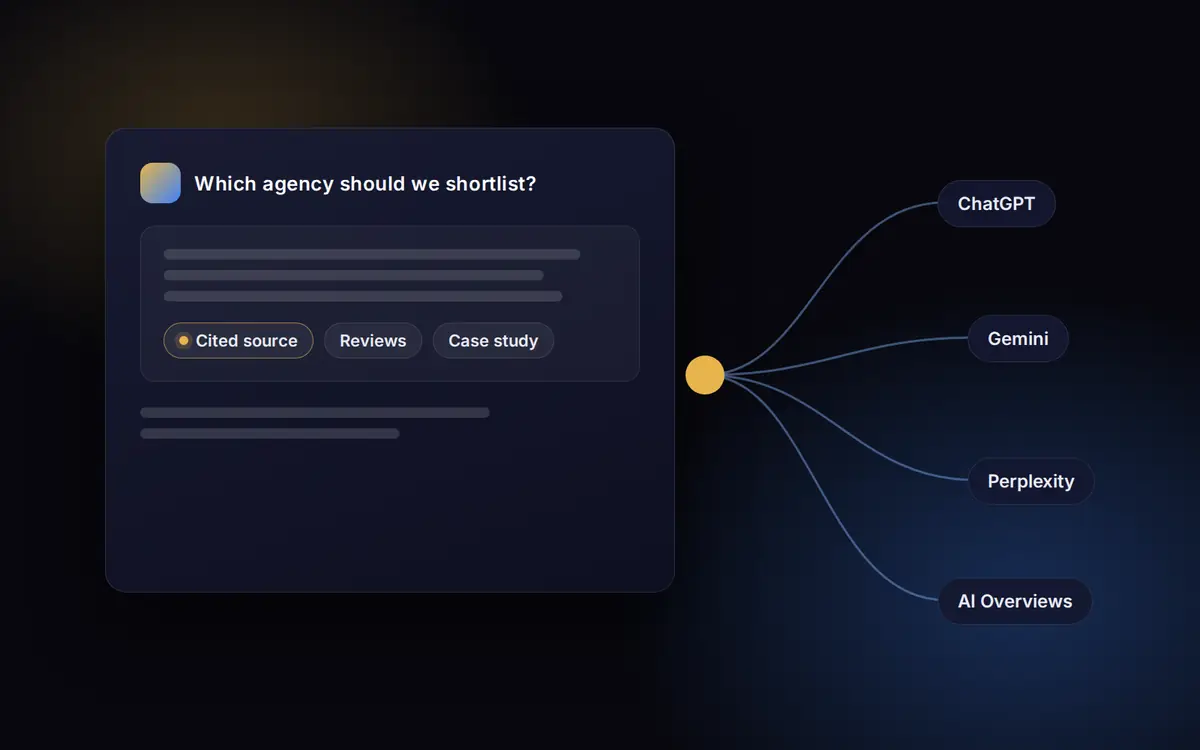
Generative engine optimisation (GEO) is the practice of improving how often and how accurately AI models such as ChatGPT, Gemini, Claude and Perplexity mention, cite and recommend a brand in the answers they generate. It combines content built to be quoted, entity and structured data work, mentions on trusted third-party sites and ongoing measurement.
Why GEO needs its own plan
Traditional SEO asks: where do we rank? GEO asks: are we in the answer, and what does the answer say about us? The two are linked but not identical. Ahrefs' 2026 benchmark found Google AI Overviews appeared on 21% of keywords overall and on 46.4% of queries seven words or longer (Ahrefs Q1 2026 AI search report via Business Wire). Longer, conversational questions are exactly where AI answers dominate, and they are often the questions buyers ask just before choosing a supplier.
The same report found most AI models repeated fabricated claims about a fictional company even when official information contradicted them (Ahrefs Q1 2026 AI search report via Business Wire). If you do not shape the evidence AI draws on, someone else's version of your story can fill the gap.
What we do
What the evidence tells us to prioritise
- Mentions over links: branded web mentions correlated with AI Overview visibility at 0.664, versus 0.218 for backlinks, across 75,000 brands (Ahrefs, 75,000-brand AI Overview study)
- Video counts: YouTube mentions were the strongest single signal of AI visibility in Ahrefs' 2026 report (Ahrefs Q1 2026 AI search report via Business Wire)
- Sources matter: Wikipedia, YouTube and Reddit were among the most cited sources in Google's AI summaries in Pew's study (Pew Research Center, July 2025)
Be wary of shortcuts. Google states that no special files or schema are needed to appear in its AI features (Google Search Central: AI features and your website), and llms.txt files have no confirmed effect on Google. The fundamentals are clear evidence, consistent facts and a crawlable site.
How we report GEO
Every month you see the prompts we track, how often you are mentioned and cited, how you are described, and how that compares with competitors. We tie changes back to the work we shipped so you can see cause and effect.
FAQ
Find out how AI sees your brand
We test your priority buyer questions across ChatGPT, Gemini, Perplexity and AI Overviews, then show you what to fix first.
Get your free audit