
AI tool categories and buyer trust are still forming, so category-definition content and honest, checkable capability claims matter more than in mature SaaS categories. AI tool directories add a meaningful discovery channel alongside organic search, especially pre-brand-awareness. Measured against signup-to-active-usage conversion, since many AI tool trials go unused.
What matters most for AI tools?
- Category-definition content, since many AI tool categories are still forming
- Honest, checkable capability claims, not exaggerated feature promises
- AI directory and listing-site visibility alongside organic search
Which channels work for AI tools?
| Channel | Role |
|---|---|
| Content Marketing | Category-definition and use-case content |
| SEO | Comparison pages against other AI tools in-category |
| Marketing Automation | Usage-triggered activation nudges post-signup |
Everyone has an AI product now, so trust is the differentiator
Buyers are tired of AI claims. Gartner estimated in 2025 that only around 130 of the thousands of vendors marketing "agentic AI" were offering genuinely agentic products, calling the rest "agent washing", and predicted over 40% of agentic AI projects would be cancelled by the end of 2027 (Gartner, June 2025). In that climate, specific and modest claims backed by demos outsell grand promises.
What we focus on
- Honest capability pages: what the product does, what it does not, and where a human still needs to check
- Category content: explaining the problem and the category, so buyers and AI assistants understand where you fit
- Comparison pages: fair comparisons with alternatives, including "build it yourself"
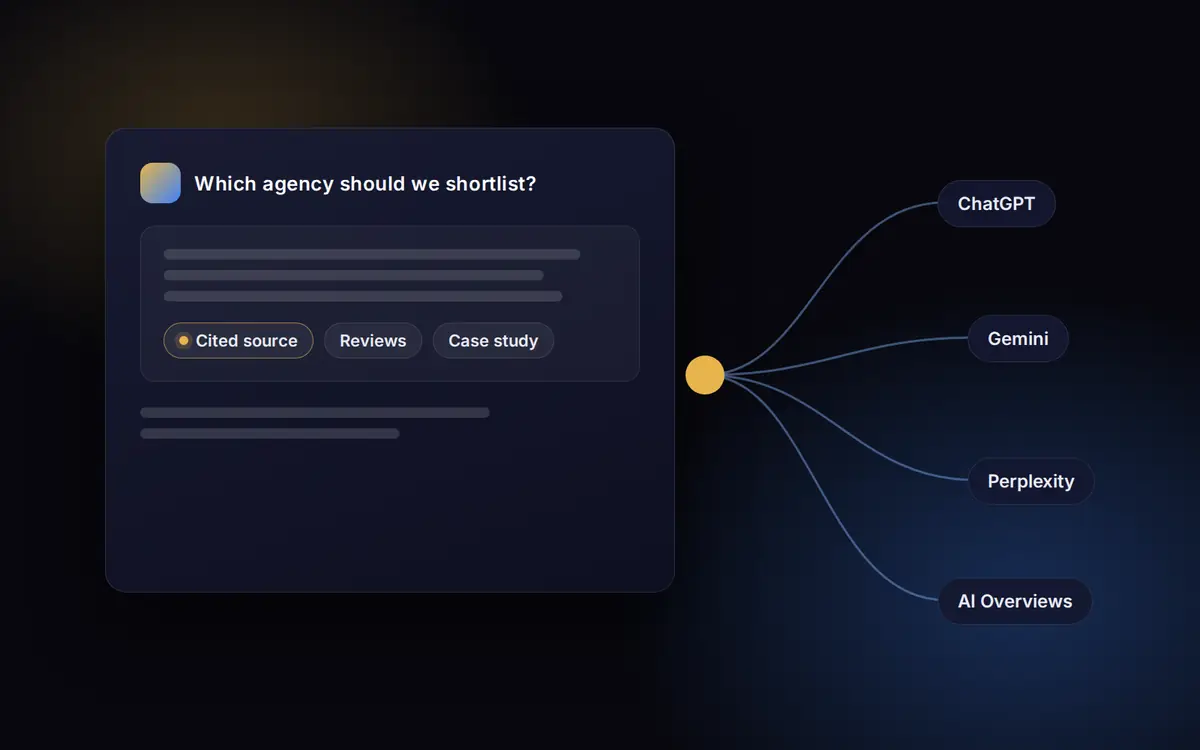
- AI search visibility: being accurately described when people ask ChatGPT, Gemini or Perplexity for tools in your category
- Activation: onboarding that gets a new user to a real result in their first session
Why AI search matters for AI products
Your buyers are heavy AI users. ChatGPT reported 900 million weekly active users in February 2026 (TechCrunch, Feb 2026), and Gartner found 45% of B2B buyers used AI during a recent purchase (Gartner, March 2026). Research presented at KDD 2024 found that adding clear statistics, quotations and sources to content could lift visibility in generative engine answers by up to 40% (Aggarwal et al., GEO, KDD 2024). See our AEO and GEO service for how we approach it.
Klarna is the cautionary tale worth knowing. Its AI assistant handled 2.3 million conversations in its first month, two thirds of customer service chats (OpenAI, Klarna case study). A year later, the CEO said the company would invest in human support again because customers must always be able to reach a person (CX Dive, May 2025). Buyers remember both halves of that story.
How we measure it
Sign-up to active user rate, time to first result, paid conversion and retention by cohort. Sign-up volume on its own tells you very little about an AI product.