
Native vs Cross-Platform Apps: Which Should You Build
Cross-platform is the right default for most consumer apps, one codebase for iOS and Android, lower cost, faster iteration. Native only pays off when the app depends heavily on platform-specific APIs or graphics performance that cross-platform tooling can't match.
When cross-platform is the right call
- Standard consumer app: content, ecommerce, booking, service marketplace
- Budget or timeline favors one codebase over two parallel builds
- Feature set doesn't depend on deep platform-specific hardware access
When native still wins
- Graphics-intensive apps (gaming, AR/VR) where frame-rate performance matters
- Deep hardware integration (camera, sensors) beyond what cross-platform APIs expose
- Platform-exclusive features that must ship on launch day
The decision in one line
Cross-platform frameworks are the right default for most business and consumer apps. Native development is worth the extra cost when the app depends on heavy graphics, deep platform features or performance that cross-platform tools cannot match.
What matters more than the framework
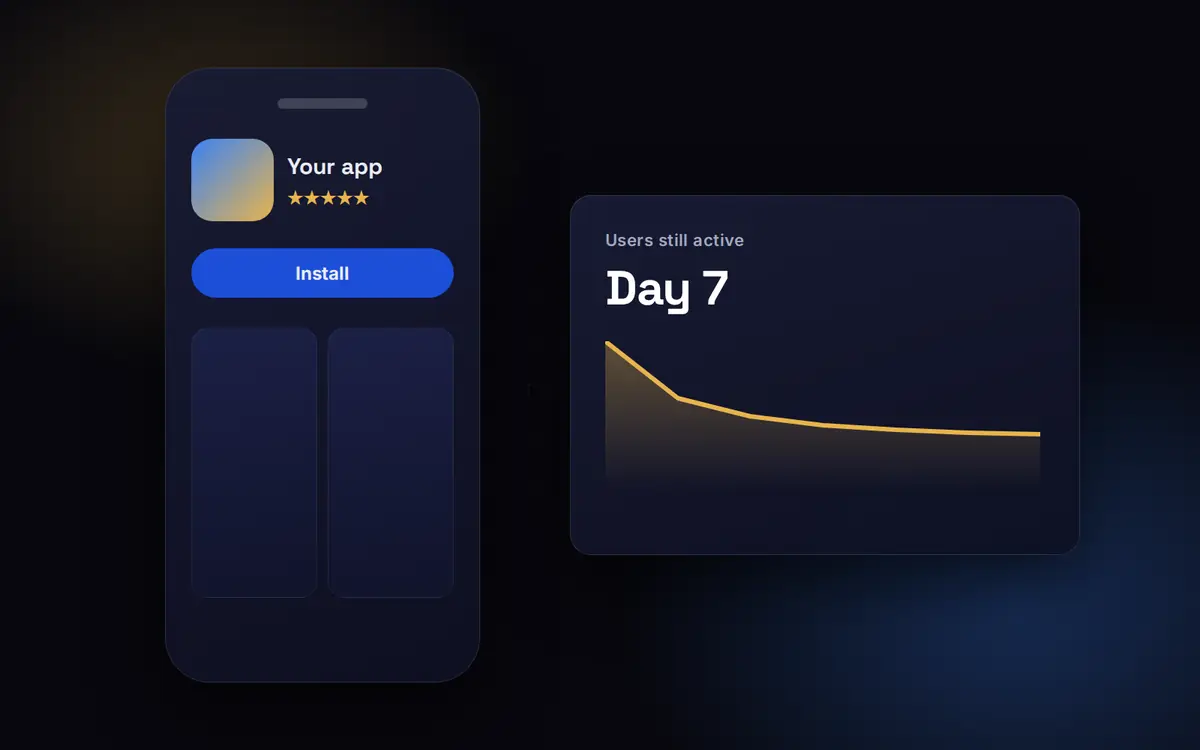
The framework rarely decides whether an app succeeds. Retention does. Adjust's benchmarks show average retention of 26% on day one and 7% by day 30 (Adjust retention guide), whichever way the app was built. Budget saved by building once for both platforms can fund the onboarding, analytics and iteration that actually move those numbers.
A practical comparison
| Factor | Cross-platform (Flutter, React Native) | Native (Swift, Kotlin) |
|---|---|---|
| Cost and speed | One codebase, faster to build and update | Two codebases, higher cost |
| Performance | Good for most apps | Best for graphics, AR, heavy processing |
| Platform features | Most available, some need native modules | Everything available on day one |
| Team | One team can cover both | Specialists for each platform |
| Best for | Content, commerce, education, booking, B2B tools | Games, camera apps, complex offline apps |
Privacy and store rules apply either way. Apple's App Tracking Transparency, which Meta said would cost it $10 billion in 2022 (CNBC, Feb 2022), affects measurement whatever you build with. Plan analytics that respect consent from the start.
What to do this week
List the three device features your app cannot live without. If all three are well supported in Flutter or React Native, start cross-platform. If one is not, prototype it natively before committing. See app development and how to plan a launch.