
What a Professional SEO Audit Actually Reveals
A real SEO audit reveals indexing gaps, Core Web Vitals problems, content gaps against named competitors, and backlink issues, delivered as a prioritized fix list, not a generic scorecard. Most sites discover at least one issue actively blocking rankings that they didn't know existed.
The four things every audit should check
- Indexing: are pages actually reachable and indexed by Google
- Technical health: Core Web Vitals, mobile usability, schema coverage
- Content gaps: keywords competitors rank for that you don't
- Backlink profile: authority signals and any toxic links to disavow
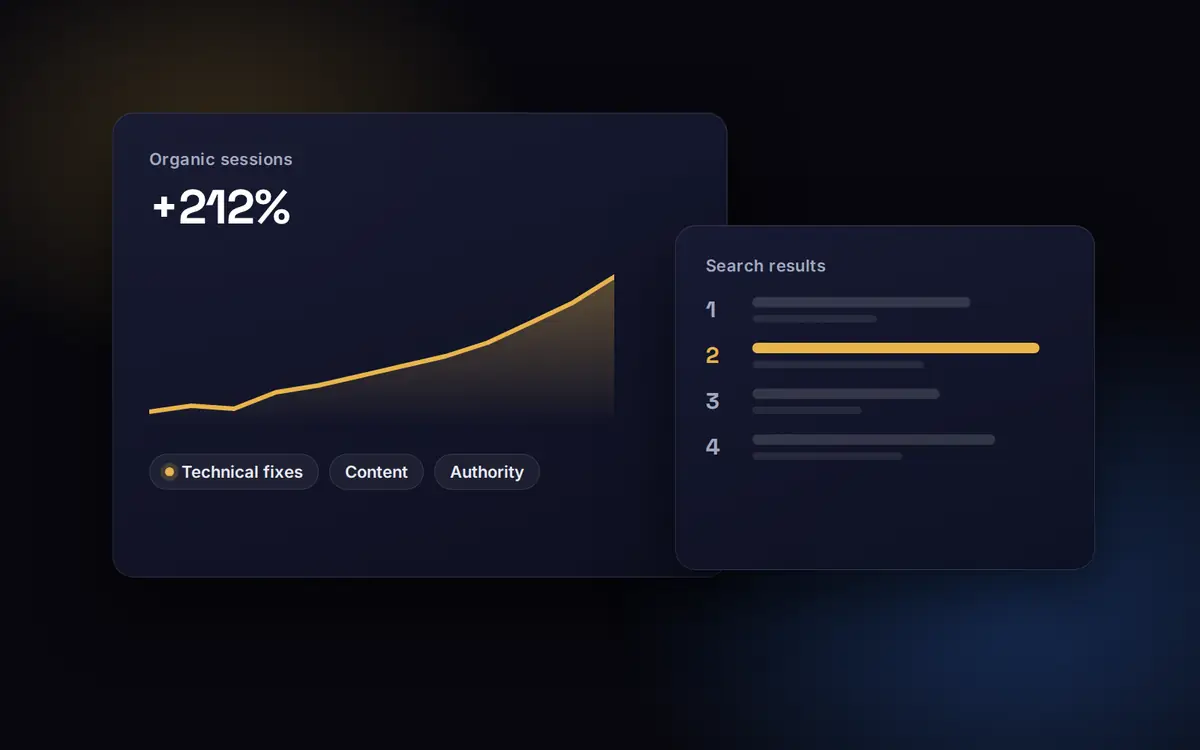
What surprises most business owners
The most common surprise is discovering pages the team assumed were indexed actually aren't, sometimes 20-30% of a site's total pages. Fixing this alone often produces more ranking improvement than a month of new content.
The findings that matter most
A good audit produces a short list of problems that are actually costing you traffic and revenue, ranked by impact. The findings we see most often, in roughly this order, are pages Google cannot index or render, pages competing with each other for the same search, slow templates, missing or broken structured data, and important pages with too few internal links.
Why each one has a commercial cost
- Indexing and rendering: if a page is not indexed, nothing else you do for it matters. Many AI crawlers also skip JavaScript, so client-rendered content can be invisible in AI answers
- Speed: The Economic Times cut Largest Contentful Paint from 4.5 to 2.5 seconds and reduced bounce rate by 43% (web.dev, The Economic Times case study)
- Thin or duplicate pages: Google's spam policies now describe scaled low-value content explicitly (Google Search spam policies), and the March 2024 update aimed to cut unhelpful content in results by around 40% (Search Engine Journal on Google's March 2024 update)
- Structured data: errors stop rich results from showing (Google: structured data intro)
Our audit of PrepLadder found roughly 30% of course pages were not being indexed because of a JavaScript template. Fixing that was central to 3.4X revenue growth.
What an audit should not be
A 90-page export of every warning a crawler can generate is not an audit. Neither is a score out of 100. If the document does not tell you what to fix first, why, and who needs to do it, it is not doing its job.
What to do with the results
Fix blockers first, then the issues on your highest-value pages, then the rest. Re-crawl after each batch to confirm the fix worked. See our SEO audit and how often to audit.