
Manufacturing and export digital marketing helps genuine procurement teams find your products, check your specifications and send an RFQ. It suits manufacturers in India selling to buyers abroad, and manufacturers elsewhere selling business to business. You get product-family and specification pages, certification and capacity pages, LinkedIn and paid campaigns for chosen markets, qualifying RFQ forms and monthly reporting on RFQs, quotes and orders by market.
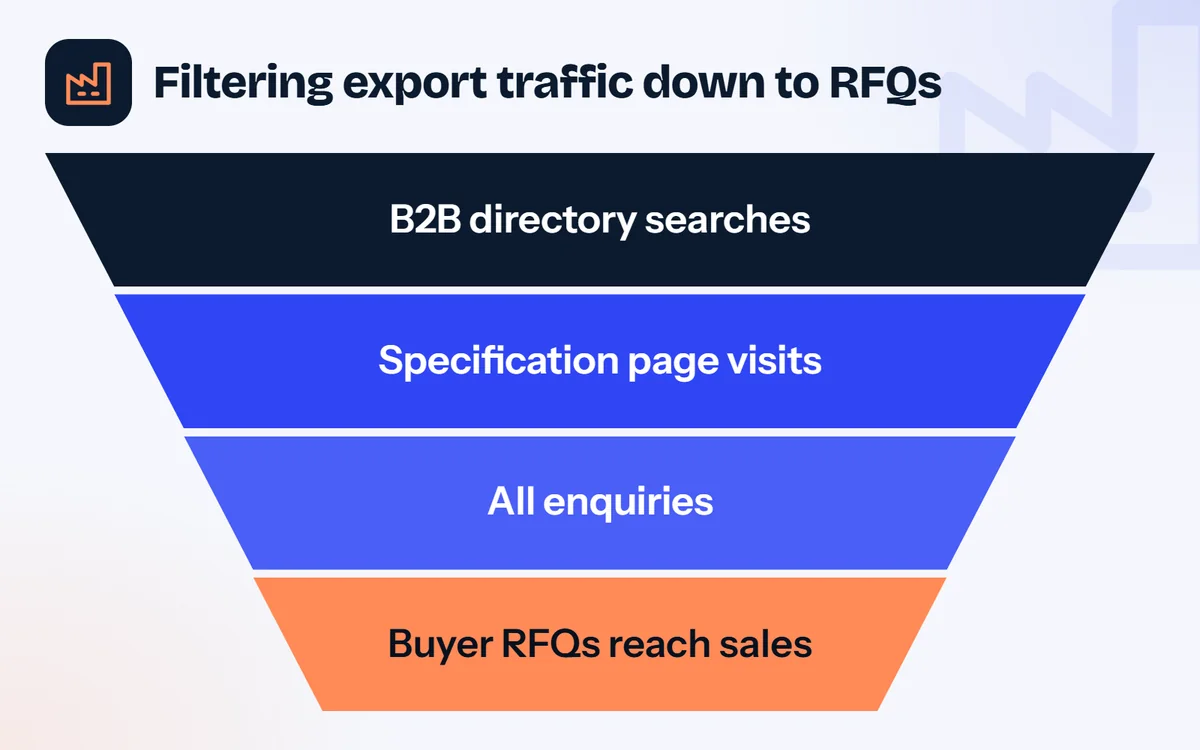
Why manufacturers get visits but few RFQs from real buyers
Your analytics show visitors from the UK, the US and the Gulf, yet the enquiries are students, competitors and traders asking for a price list. The procurement manager you wanted looked at a brochure-style product page, found no tolerances, standards or lead times, and moved on to a supplier who listed them.
Procurement teams search in their own language: a material grade, a standard, a part type, a capacity. A site written around your company story rather than those terms is hard to find and harder to evaluate, so the RFQ goes elsewhere even when your product is the better fit.
The timing matters for Indian exporters. The India and UK Comprehensive Economic and Trade Agreement came into force on 15 July 2026, giving duty-free access on around 99% of UK tariff lines, according to the Press Information Bureau. The manufacturers who are easy to find and easy to evaluate win the first wave of new buyers.
Who this suits, and when it is the wrong tool
It suits component, engineering, textile, leather, food-processing and industrial goods manufacturers that sell to other businesses and can supply the specifications buyers ask for. It works for a first export market or for a firm already shipping to several.
It is the wrong tool if your capacity is already sold out for the year, or if you only want marketplace enquiries and have no interest in your own site. Manufacturing is not a sector where we have past client work, so this page describes how we would approach your account rather than claiming results. If you run the freight side rather than the factory, see logistics digital marketing.
What procurement teams need to see before they send an RFQ
- Product families with full specifications, standards and tolerances, one page per family
- Certifications and quality systems, stated clearly with evidence such as certificate numbers or audit summaries
- Capacity, minimum order quantities and lead times, so buyers can rule you in or out quickly
- Export experience: markets served, Incoterms you work to and the documentation you handle
- Named customers or case studies, only where you are allowed to share them
- An RFQ form that asks for part, quantity, destination and timing, so sales sees a real enquiry
How we bring RFQs in, and where marketplaces fit
| Channel | What it does for a manufacturer |
|---|---|
| Specification-level SEO | Pages for the exact searches procurement teams use |
| Content and account targeting aimed at buyers in your export markets | |
| Google and LinkedIn campaigns | Faster demand in a new market while SEO builds |
| Lead qualification | RFQ forms and scoring that filter out non-buyers before sales calls |
Each channel has its own page: manufacturing SEO, manufacturing LinkedIn and social media, manufacturing paid media and the full-stack manufacturing package.
B2B marketplaces bring volume, but the enquiries are often price-led and the buyer belongs to the platform. Your own site is where you win on quality, reliability and specification, so we treat marketplaces as a supporting channel rather than the plan.
How working together goes, from audit to orders won
We open with a free audit of your site, rankings and the suppliers who appear for your product terms in your target market, delivered in 3 to 5 business days. It also tells you which product families have real search demand abroad.
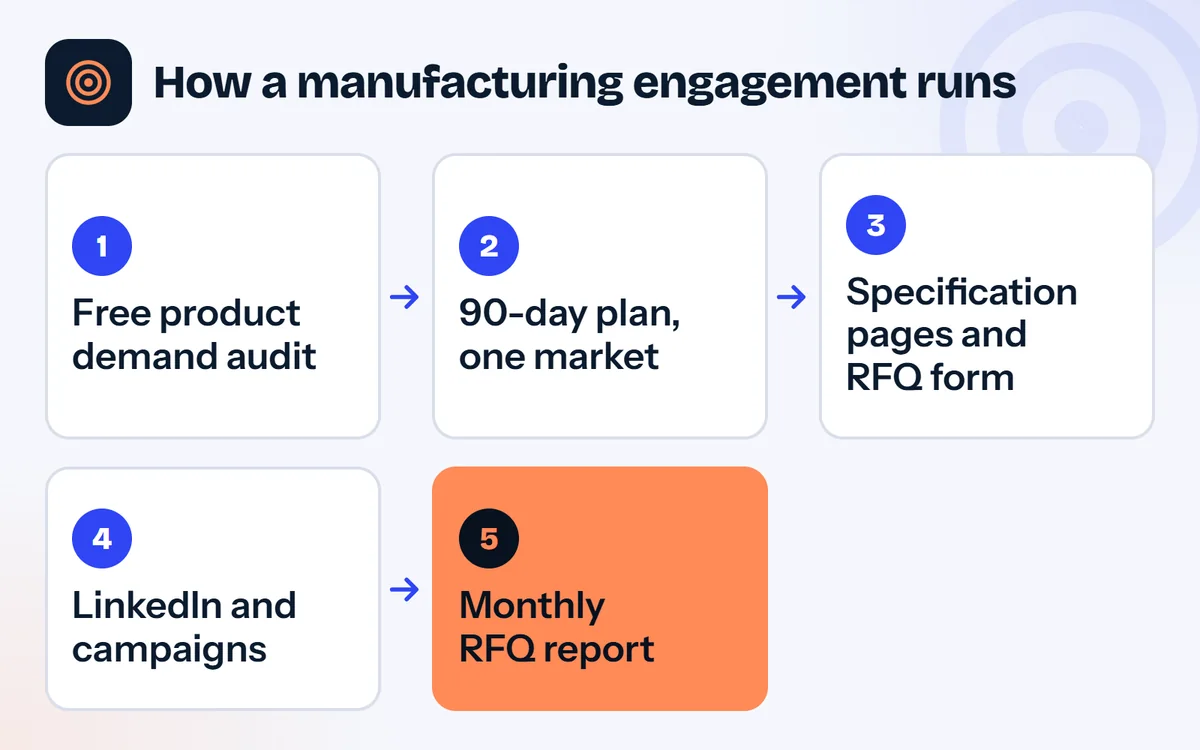
You receive a 90-day plan with priorities and a fixed monthly price, usually centred on one export market where you already have customers or a new tariff advantage. Proving demand in one market funds the next.
A named senior specialist runs the work end to end: specification pages and the RFQ form first, then LinkedIn and campaigns for the chosen market. Each month brings one plain report on qualified RFQs by market and product, quote rate, orders won and average order value.
What we would check first on a manufacturer's site
We have no published manufacturing case study, and the results on our case studies page come from consumer brands, so we will not present them as evidence here. On your site we would first compare the product terms buyers in your target market search with the pages you actually have, and read the last few months of enquiries to see how many came from genuine procurement teams.
That shows whether the gap is missing specification pages, missing proof such as certifications, or a form that lets everyone through.
Working with us as an Indian exporter or an overseas manufacturer
Manufacturers and exporters in India can share drawings, catalogues and certificates with us on WhatsApp at +91 70096 23687, talk on calls in IST and visit our office in Mansa, Punjab. We plan your pages for the buyers abroad you want, not only for searches in India.
Manufacturers based abroad get a working slot inside their business hours, monthly rolling contracts and every account and page held in the company's name. Support is answered 24/7, so a question sent in your morning does not wait for the Indian working day.