
How Long Does SEO Take to Show Results?
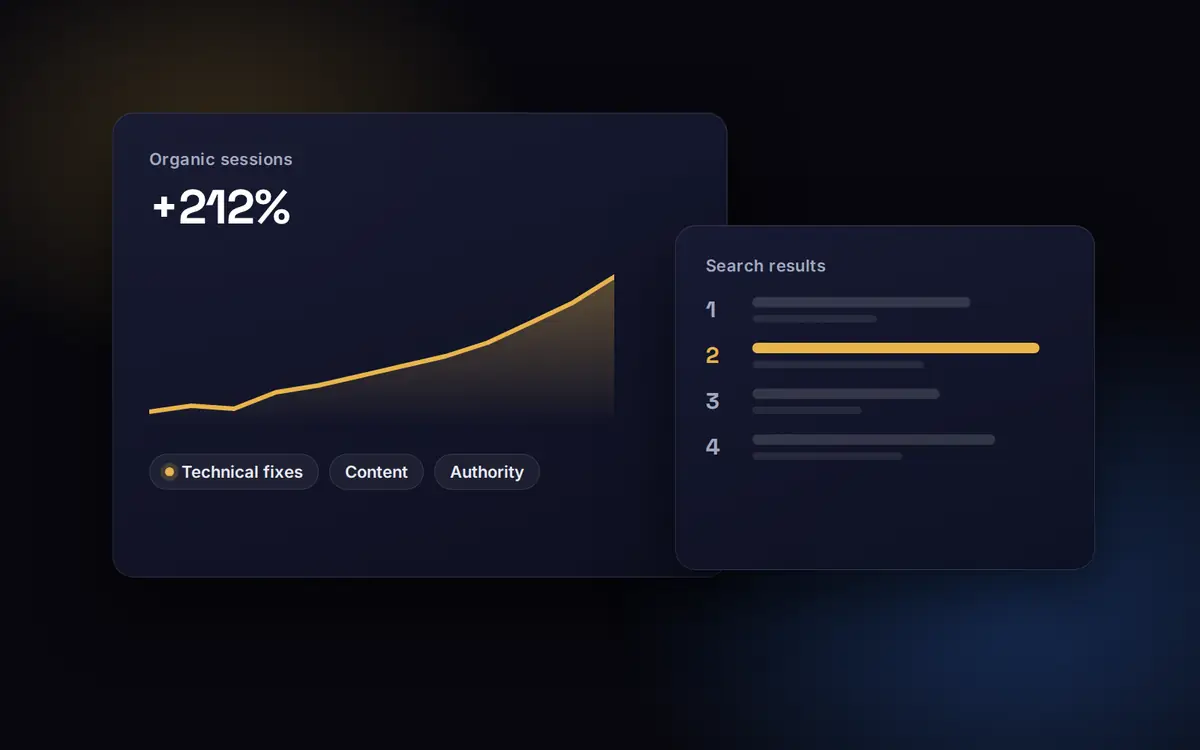
Most SEO engagements show first ranking movement at weeks 8-12, with compounding organic traffic gains through month 6. New domains typically need 4-6 months before competitive rankings are realistic. Google's own guidance states most sites shouldn't expect meaningful results for four months to a year.
What happens week by week?
| Weeks | What's happening |
|---|---|
| 1-4 | Technical crawl fixes, indexing, keyword mapping |
| 4-8 | Content published, internal linking built |
| 8-12 | First ranking movement typically appears |
| Month 6+ | Compounding traffic gains, why SerpHike scopes a 6-month minimum |
Why do new domains take longer?
New domains lack the authority signals (backlinks, historical traffic) that established sites already carry. Technical foundations still matter immediately, but competitive rankings realistically take 4-6 months for a new domain versus 8-12 weeks for an established one with fixable technical issues.
What the public evidence says about SEO timelines
Google is unusually direct about this. Its SEO Starter Guide says most changes take time to be reflected in search and that sites should generally expect results over a period of four months to a year (Google SEO Starter Guide). Anyone promising page one in a fortnight is either working on a search nobody makes or taking risks with your domain.
The timeline has also stretched for low-quality work. Google said its March 2024 core update would cut low-quality, unoriginal content in results by around 40% (Search Engine Journal on Google's March 2024 update), and its spam policies now name scaled content abuse explicitly (Google Search spam policies). Shortcuts that used to produce fast, temporary gains now tend to produce fast, lasting losses.
A worked example
Take a mid-sized services business with a five-year-old domain, decent reviews and a slow WordPress site. In weeks one to four we would fix indexing and speed, and map one page to each commercial search. Weeks four to eight would bring rewritten service pages and new location pages. The first ranking movement usually shows between weeks eight and twelve, often for long-tail searches first. The bigger, head-term movement tends to come between months four and nine, which is exactly the window Google describes.
Our PrepLadder engagement ran for nine months and grew revenue 3.4X, mostly from organic enrolments once an indexing gap was fixed.
What speeds things up, and what does not
- Speeds it up: fixing indexing first, strong existing authority, clear commercial pages, genuine reviews and links
- Does not: publishing lots of thin articles, buying links, or changing everything at once so you cannot tell what worked
What to do this week
Check how many of your important pages are actually indexed in Google Search Console, and how fast they load on a mid-range phone. If either answer is bad, that is where your timeline is being lost. Our free SEO audit covers both.